[Calculation 6] Kummer's Theorem
Translated from the Korean original. Read the original →
|
Theorem. (Kummer's Theorem) {}_2 F_1 (a,b;1+a-b;-1) = \frac{\Gamma(1+a-b)\Gamma\left(1+\frac{1}{2}a\right)}{\Gamma(1+a)\Gamma\left(1+\frac{1}{2}a-b\right)}
|
To prove Kummer's theorem, we introduce the following lemma, which is called Kummer's quadratic transformation:
|
Lemma. (Kummer's Quadratic Transformation) \begin{equation}\tag{1}
{}_2 F_1 (a,b;1+a-b;z) = (1-z)^{-a} {}_2 F_1 \left( \frac{1}{2}a, \frac{1}{2}+\frac{1}{2}a-b; 1+a-b; - \frac{4z}{(1-z)^2} \right)
\end{equation} holds for |z|<1. |
Proof of Lemma. Note that the right hand side of (1) is analytic inside the loop of the curve |4z|=|1-z|^2 which surrounds the origin as below.
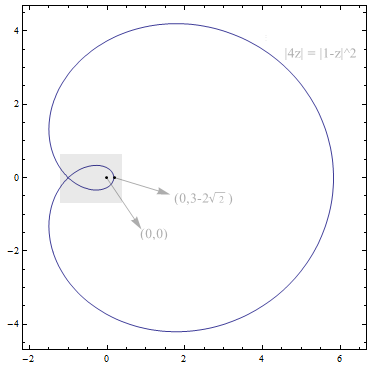
Therefore the right hand side of (1) can be expanded in powers of z when |z|<3-2\sqrt 2. Thus
\begin{array}{rcl}
\text{(rhs)}
&=&
(1-z)^{-a} \sum_{k=0}^\infty \frac{(\frac{1}{2}a)_k (\frac{1}{2} + \frac{1}{2}a-b)_k}{(1+a-b)_k k!}\left( -\frac{4z}{(1-z)^2}\right)^k\\
&=&
\sum_{k=0}^\infty \frac{(\frac{1}{2}a)_k (\frac{1}{2} + \frac{1}{2}a-b)_k (-4)^k}{(1+a-b)_k k!}z^k (1-z)^{-a-2k}\\
&=&
\sum_{k=0}^\infty \sum_{r=0}^\infty \frac{(\frac{1}{2}a)_k (\frac{1}{2} + \frac{1}{2}a-b)_k (-4)^k}{(1+a-b)_k k!} \frac{(a+2k)_r}{r!}z^{k+r}.
\end{array}
Calculating the coefficient of z^n, we get
\begin{equation}\tag{2}
\sum_{k=0}^n \frac{(\frac{1}{2}a)_k (\frac{1}{2} + \frac{1}{2}a-b)_k (-4)^k}{(1+a-b)_k k!} \frac{(a+2k)_{n-k}}{(n-k)!}
=
\frac{(a)_n}{n!}\sum_{k=0}^n \frac{(\frac{1}{2}+\frac{1}{2}a-b)_k (a+n)_k (-n)_k}{(1+a-b)_k (\frac{1}{2} + \frac{1}{2}a)_k k!},
\end{equation}
where we applied the relations
\frac{1}{(n-k)!} = \frac{(-1)^k (-n)_k}{n!}
and
(a+2k)_{n-k} = \frac{(a)_n(a+n)_k}{4^k (\frac{1}{2}a)_k (\frac{1}{2} + \frac{1}{2}a)_k}.
Therefore using Saalschütz’s Theorem to the right hand side of (2), we obtain
\begin{array}{rcl}
\frac{(a)_n}{n!}\sum_{k=0}^n \frac{(\frac{1}{2}+\frac{a}{2}-b)_k (a+n)_k (-n)_k}{(1+a-b)_k (\frac{1}{2} + \frac{a}{2})_k k!}
&=&
\frac{(a)_n}{n!} {}_3 F_2 \left( \frac{1}{2} + \frac{a}{2} -b, a+n, -n; 1+a-b, \frac{1}{2} + \frac{a}{2};1 \right)\\
&=&
\frac{(a)_n}{n!} \frac{(\frac{1}{2}+\frac{1}{2}a)_n (a-b-n)_n}{(1+a-b)_n(\frac{1}{2}-\frac{1}{2}a-n)_n}\\
&=&
\frac{(a)_n (b)_n}{n!(1+a-b)_n}
\end{array}
so that
\text{(rhs)} = \sum_{n=0}^\infty \frac{(a)_n (b)_n}{n!(1+a-b)_n} z^n = {}_2 F_1 (a,b;1+a-b;z),
which proves Lemma for |z|<3-2\sqrt 2, and the complete result follows by analytic continuation.\square
Proof of Theorem. Limiting z\to -1 in Lemma, we obtain
\begin{array}{rcl}
{}_2 F_1 (a,b;1+a-b;-1)
&=&
2^{-a} {}_2 F_1 \left( \frac{1}{2}a, \frac{1}{2}+\frac{1}{2}a-b; 1+a-b; 1\right)\\
&=&
2^{-a} \frac{\Gamma(1+a-b)\Gamma(\frac{1}{2})}{\Gamma(1+\frac{1}{2}a-b)\Gamma(\frac{1}{2}+\frac{1}{2}a)}\\
&=&
\frac{\Gamma(1+a-b)\Gamma\left(1+\frac{1}{2}a\right)}{\Gamma(1+a)\Gamma\left(1+\frac{1}{2}a-b\right)},
\end{array}
where we used the Gauss Summation Formula for the second equality, and the Duplication Formula for the Gamma function:
\Gamma\left(\frac{1}{2} + \frac{1}{2}a\right) = \frac{2^{-a}\Gamma(\frac{1}{2})\Gamma(1+a)}{\Gamma(1+\frac{1}{2}a)}
for the last equality.\square
Errata : (0,3-2\sqrt 2) should be replaced by (3-2\sqrt 2,0).
[1] W. N. Bailey, Generalized Hypergeometric Series, Cambridge University Press, 1964, pp.9-10.
[2] Bruno Gauthier, A Proof of Kummer's Theorem, 2008. (arXiv:math/9904061v2)
[3] Leun Kim, Saalschütz’s Theorem.
[4] Leun Kim, Gauss's Summation Formula.
Comments 0