[Kyoto Day Trip] Kiyomizu-dera Temple (清水寺)
Translated from the Korean original. Read the original →
It's another temple on the UNESCO World Heritage list.
After visiting Kinkakuji, we arrived at Kiyomizu-dera,
which, like Kinkakuji, has also been designated a UNESCO World Heritage Site.
We weren't sure how to get from Kinkaku-ji to Kiyomizu-dera,
so we went back to Kyoto Station first and grabbed a taxi from there.
Luckily it isn't very far from the station,
so the fare didn't come to much, as I recall.
Since we did not know how to go to Kiyomizu-dera directly from Kinkakuji,
we first went to Kyoto Station.
Then we got a taxi to Kiyomizu-dera.
Fortunately, the taxi fare was not that expensive.
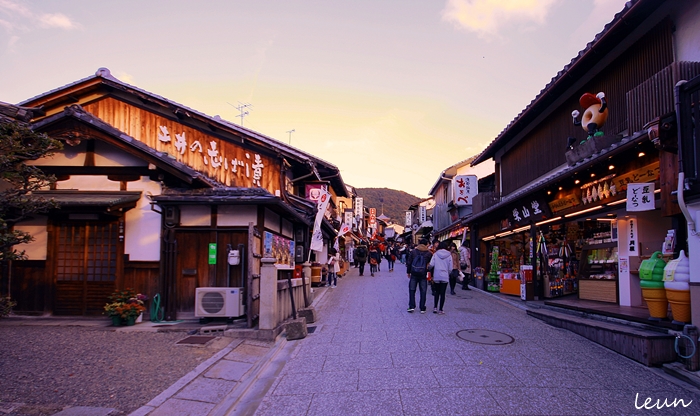
This is the street we saw as soon as we got out of the taxi.
Just as you'd expect, it's lined with buildings that have that old Kyoto feel.
After a few minutes, we arrived at the entrance to Kiyomizu-dera.
The slopes leading up to Kiyomizu-dera are called Ninenzaka (二年坂) and Sannenzaka (三年坂),
because legend has it that if you trip and fall here, you'll die within two or three years.
So you won't see anyone running on these streets.
So everyone, watch your step!
This street is called Ninenzaka or Sannenzaka,
which means "2-year street" and "3-year street".
Legend says that if you fall at Ninenzaka,
you will die within two or three years.
Therefore, on this street, no one runs.
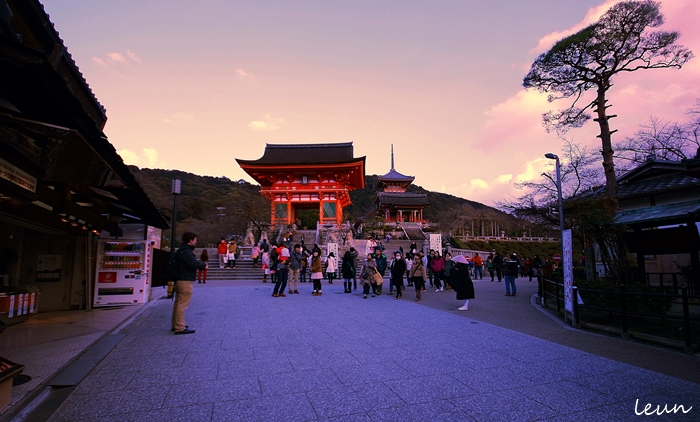
We kept walking up the street, and there it was at last: the entrance to Kiyomizu-dera!
Finally, we arrived at the main gate to Kiyomizu-dera!
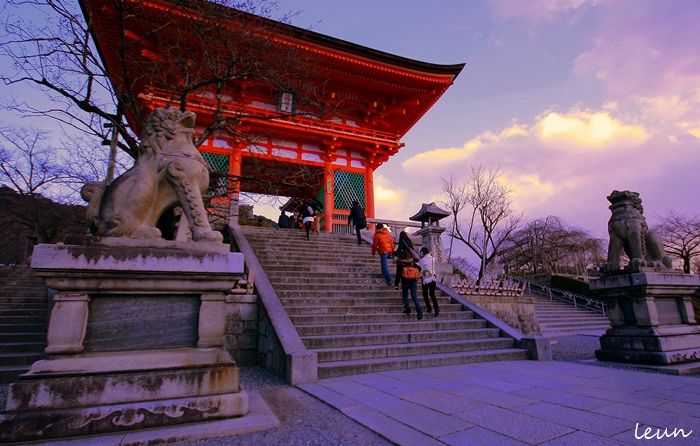
Maybe because it was late afternoon, or maybe because it was cold,
there weren't that many tourists, thankfully.
Fortunately, there were not that many visitors.
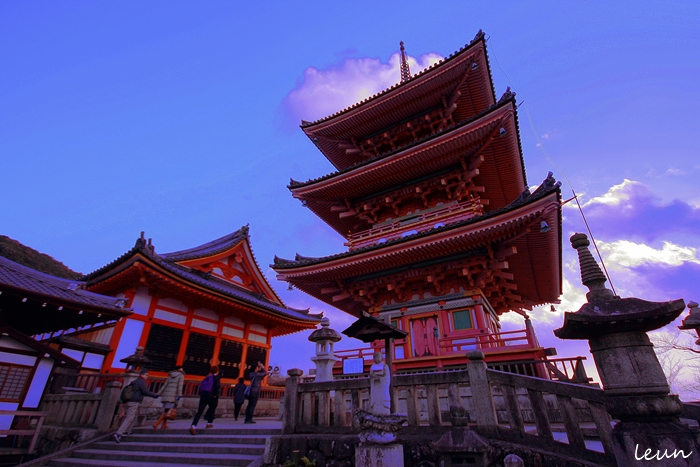
Buildings that feel unmistakably Japanese.
Kiyomizu-dera was apparently founded in 798, in the Heian period.
Most of the buildings you see today, though, were rebuilt in 1633 under Tokugawa Iemitsu.
Kiyomizu-dera was founded in the early Heian period.
The temple was founded in 798,
and its present buildings were constructed in 1633, ordered by Tokugawa Iemitsu.
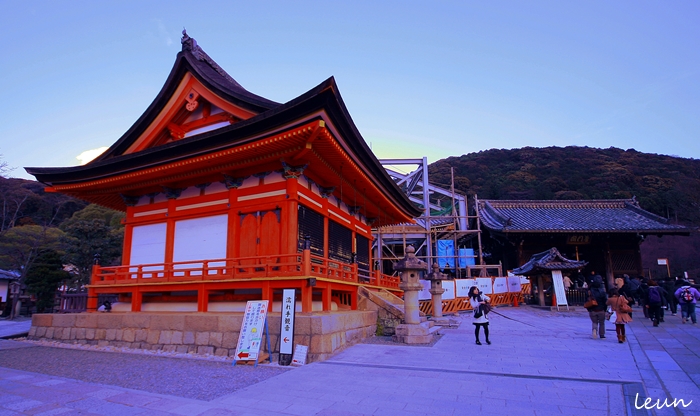
The only letdown was that some restoration work was going on when I visited.
But some of the halls and pagodas were under repair.
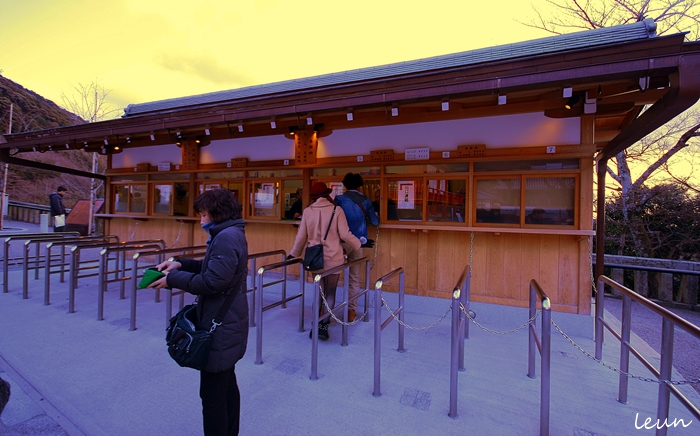
This is the ticket office.
A ticket counter.
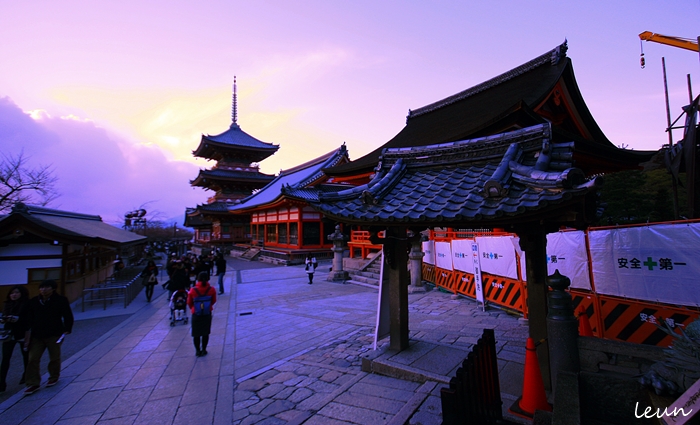
Kiyomizu-dera under renovation.
Some places were under repair.
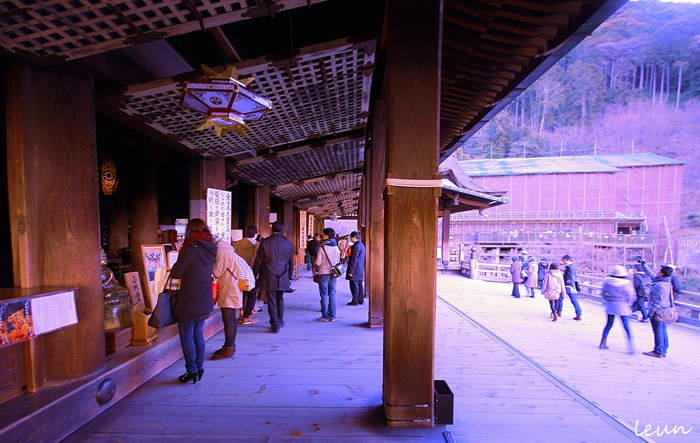
Now we're in the Main Hall, built out over the hillside like a stage.
The hall itself is great, but the real highlight is the sweeping view of nature off to the right.
We reached the main hall, built in the "stage" style.
It has beautiful background scenery which changes with the four seasons.
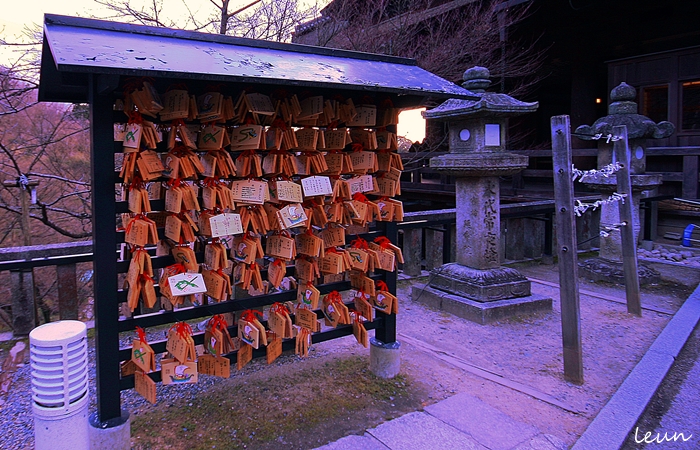
There were wooden plaques with people's wishes written on them, too...
These are prayer boards.
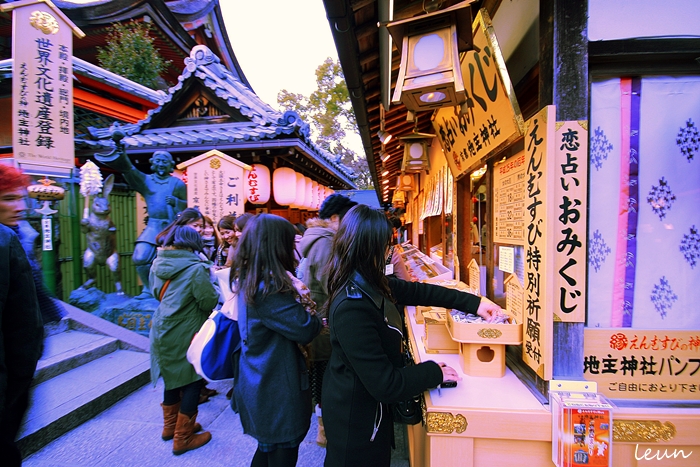
This spot looks like a place for fortune-telling.
People buy omikuji (fortune slips) here and tie them onto strings, kind of like the love locks at N Seoul Tower.
This is a love fortune-telling house.
There are some omikuji, fortunes or blessings written on paper.
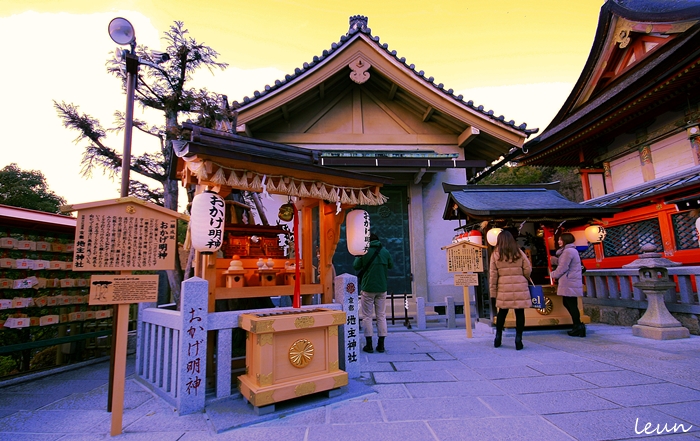
It's common for Japanese Buddhist temples to have a Shinto shrine (神社) on their grounds like this.
Some jinja (神社) shrines in the temple.
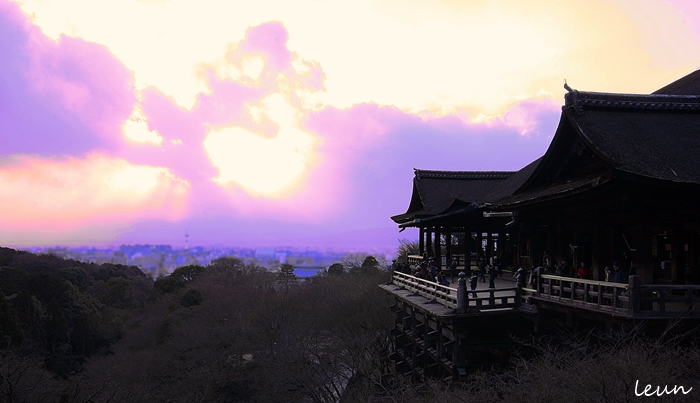
Then we followed the mountain path around the back and reached a really famous spot (I think?).
Looking down at the hills, Kiyomizu-dera, and Kyoto city far off in the distance, the view was absolutely stunning.
I don't think this photo captures even 10% of what it felt like. Sigh.
We arrived at the most famous place in Kiyomizudera.
You can see really beautiful scenery at this spot.
By the way, legend has it that if you jump from the railing of the 13-meter-high Main Hall on the right and survive, your wish will come true.
Apparently a lot of people actually jumped, since the survival rate was fairly high.
That's why, as you can see, there's now a framework built underneath so nobody can jump.
Kiyomizu-dera has an interesting history.
Many people used to jump off its 13-meter-high stage there.
Anyone who survived the fall was supposedly granted a wish.
So to prevent jumping off, as you can see, there are some footholds now.
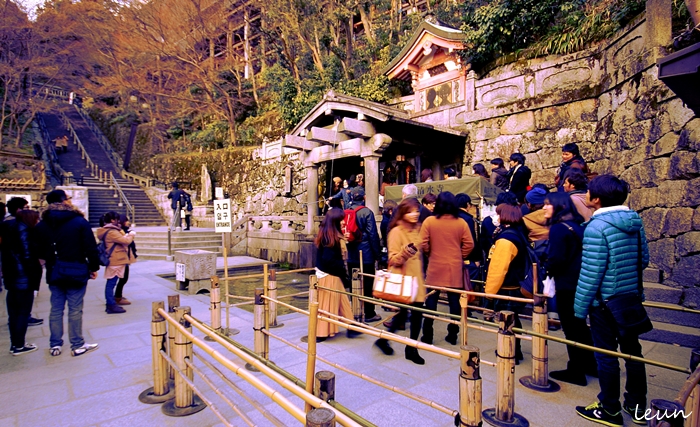
This is Otowa Waterfall (Otowa-no-taki), where the water falls in three separate streams.
The three streams stand for health, love, and learning, and drinking from one is said to bring you luck in that area.
You're supposed to drink from no more than two. If you drink from all three, it's said your luck actually turns bad.
Here is Otowa Waterfall.
The water is divided into three separate streams.
Each stream is said to have a different benefit,
namely to cause longevity, love, and success at school.
However, if you drink all three streams, misfortune comes.
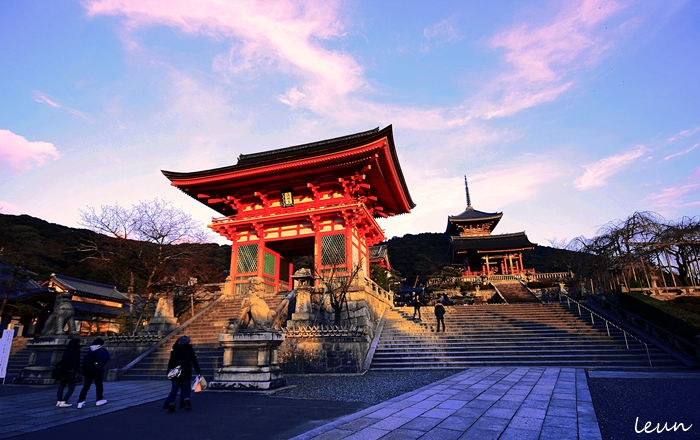
After soaking up the scenery to our hearts' content,
we made it back to the entrance just as the temple was about to close.
We came back to the entrance near closing time.
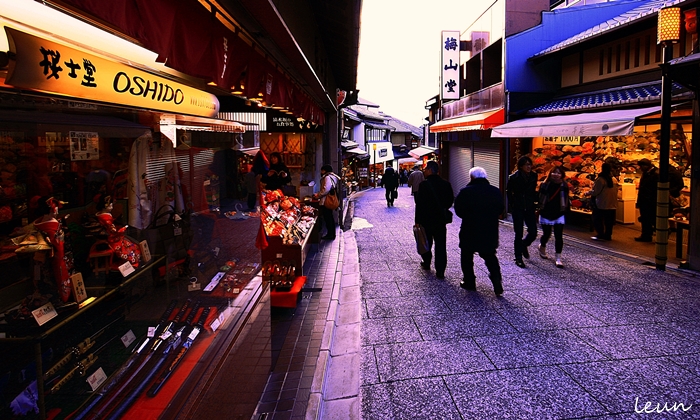
On the way down, we browsed all kinds of food and souvenirs..
Souvenir shops.
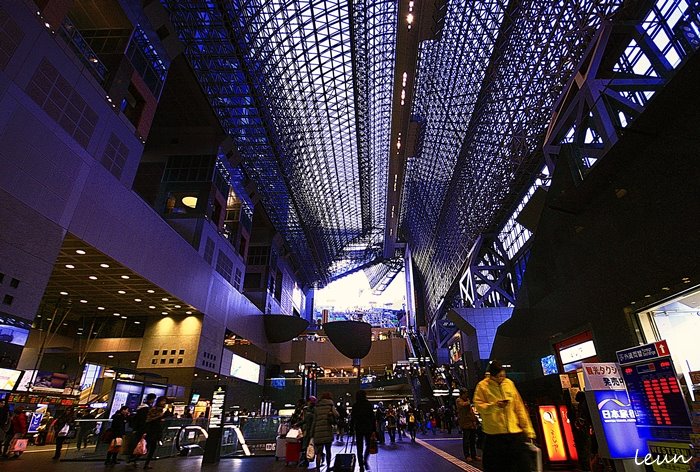
We got to Kyoto Station to head back to Osaka.
Since I didn't really know my way around Kyoto's public transportation,
even seeing two places in one day turned out to be tough. T_T
To go back to Osaka, we arrived at Kyoto Station.
I think it's a bit hectic to visit more than two places in a day.
Well then, goodbye, Kyoto!
Good bye Kyoto!
More in In Osaka
See all- Minoh, Osaka – A Late-Night Walk Around the Neighborhood to Settle My Stomach
- Ordering Pizza Hut Delivery in Japan Again – Am I Addicted to Pizza?(2)
- [Kyoto Day Trip] Kiyomizu-dera Temple (清水寺)(4)
- Kyoto Day Trip: Kinkaku-ji, the Golden Pavilion(4)
- [Late-Night Snack] Japanese Mochi: Salt Butter Mochi (塩バター餅) from FamilyMart(4)
Comments 4
(그림은 원래 사이트가 없어져 보이지 않아요)
적절했다..ㅠ
Thanks for this meaningful sharing. I didn't go to 清水寺that time, ㅠ.. But surely i enjoyed walking on the street there. Free food testing and so on.. Going to Kyoto can see there are many Kimono girls too! ^^
haha you can wear Kimono, too!