Why Is an Octave Divided into 12 Notes? The Math Behind the 12-Tone Scale
Translated from the Korean original. Read the original →
The reason is actually pretty simple. I'm confident that by the time you finish this post, it will all make perfect sense. (By the way, the frequencies you'll hear below don't exist in today's 12-note scale.)
As everyone knows, the pitch of a sound is determined by its frequency. So how far apart in frequency are two notes that are an octave apart? Exactly 1:2. For example, if you pick any frequency (let's call it f_0), you can think of the note at exactly twice that frequency, 2f_0. In other words, the interval between a note and the note at twice its frequency is called an octave. Have a listen to the simple example below. From here on I'll drop the "Hz." Also, when f_i and f_j are played together, I'll write it as f_i \oplus f_j.
| f_0 = 300 | |
| 2f_0 = 600 | |
| f_0 \oplus 2f_0 |
How was that? Hearing the two notes together doesn't sound off at all, right? When we hear a chord built on the mathematically "simplest" whole-number ratio, 1:2, it feels calm and settled. In other words, two notes whose frequencies differ by a factor of 2 are "almost" the same note. That naturally raises a question: "What about the next simplest ratio, 1:3?" Listen to the example below.
| f_0 = 300 | |
| 3f_0 = 900 | |
| f_0 \oplus 3f_0 |
How about that? Not as smooth as 1:2, but still fairly pleasant. (If you don't think so, please just go along with me for now.) The problem is that tripling f_0 pushes the frequency way up, so the pitch ends up much higher than f_0. For various reasons, we'd like every new note we create to fall between f_0 and 2f_0. Is there a good stand-in for this high 3f_0? Yes, there is: the note in a 1:2 ratio with it, which we just saw is "almost" the same note. That gives us the candidate 3f_0 / 2 = 1.5 f_0. Now let's play f_0 and 1.5 f_0 together.
| f_0 = 300 | |
| 1.5f_0 = 450 | |
| f_0 \oplus 1.5f_0 |
Yep, that's definitely easier on the ears. This chord is what has long been called the "perfect fifth." But the one you're hearing right now is the "real" perfect fifth. Does that mean the perfect fifths in the music you hear every day (C and G, for example) are "fake"? Yes, they are. In all the music you listen to, the frequency ratio of the perfect fifth is not 1:1.5. "Isn't that just because of small errors in the instruments or software?" No. Nobody building instruments or producing music even tries to tune C and G to exactly 1:1.5 in the first place. Instead, they aim for a value slightly smaller than 1.5 (1.498). You'll see why by the end of this post.
So far, starting from an arbitrary frequency f_0, we've found 2f_0 and 1.5f_0. All three notes lie in the interval [f_0, 2f_0]. Now I want to find more notes in this interval. The next note to consider is the one in a 1:3 ratio with our new note 1.5f_0, namely 4.5f_0. But 4.5f_0 is way too high as well. So, just like before, let's take the note at half the frequency of 4.5f_0, which is 2.25f_0. That one still doesn't fit inside [f_0, 2f_0], so we halve it again and get 1.125f_0. Luckily, this time it lands inside the interval. Let's listen to 1.125f_0, which we got from 1.5f_0.
| 1.5f_0 = 450 | |
| 1.5f_0 * 3 / 2^2 = 337.5 | |
| 1.5f_0 \oplus 1.125f_0 |
There you go. The note we just found, 1.125f_0, is again a perfect fifth from 1.5f_0. Sharp-eyed readers may have noticed that 1.125 f_0 can also be written as (1.5)^2 f_0 /2. Next, of course, we look for the perfect fifth of this new note 1.125f_0. In other words, we repeat the step "multiply by 3, then keep halving until it falls inside our interval." Doing that gives us the note 1.125 f_0 * 3 /2 = (1.5)^3 f_0 /2 = 1.6875f_0. Naturally, this note is a perfect fifth from 1.125f_0. Now I'd like to keep repeating this process.
Let's pause for a moment and sum up the notes we have so far. Starting from an arbitrary f_0, we considered 2f_0, then got 1.5f_0, the perfect fifth of f_0. For convenience, let 1.5 f_0 = f_1. From this f_1 we got its perfect fifth, 1.125f_0. For convenience, let 1.125 f_0 = f_2. And from there we got as far as 1.6875f_0 =: f_3.
I'd like to keep repeating this, but I'd also like it to end at some point. In other words, after a finite number of steps, I'm hoping a note will eventually show up that matches one we've already found. (If you know a bit of algebra, think of a cyclic group.) For now, here's what we get after repeating the process 15 times. Of course, f_{i+1} is a perfect fifth from f_i.
| f_0 = 300 | ||
| f_1 = 450 | f_1 = (1.5)f_0 | |
| f_2 = 337.5 | f_2 = \frac{(1.5)^2 f_0}{2} | |
| f_3 = 506.25 | f_3 = \frac{(1.5)^3 f_0}{2} | |
| f_4 = 379.688 | f_4 = \frac{(1.5)^4 f_0}{2^2} | |
| f_5 = 569.531 | f_5 = \frac{(1.5)^5 f_0}{2^2} | |
| f_6 = 427.148 | f_6 = \frac{(1.5)^6 f_0}{2^3} | |
| f_7 = 320.361 | f_7 = \frac{(1.5)^7 f_0}{2^4} | |
| f_8 = 480.542 | f_8 = \frac{(1.5)^8 f_0}{2^4} | |
| f_9 = 360.406 | f_9 = \frac{(1.5)^9 f_0}{2^5} | |
| f_{10} = 540.61 | f_{10}=\frac{(1.5)^{10} f_0}{2^5} | |
| f_{11} = 405.457 | f_{11}=\frac{(1.5)^{11} f_0}{2^6} | |
| f_{12} = 304.093 | f_{12} = \frac{(1.5)^{12} f_0}{2^7} | |
| f_{13}=456.139 | f_{13} = \frac{(1.5)^{13} f_0}{2^7} | |
| f_{14}=342.105 | f_{14} = \frac{(1.5)^{14} f_0}{2^8} | |
| f_{15}=513.157 | f_{15}= \frac{(1.5)^{15} f_0}{2^8} |
It doesn't mean much yet, but let's play these 15 notes in order, from lowest to highest.
So, how did that sound? The steps between the notes sound uneven to our ears (and they really are). That's to be expected: we've only repeated the process 15 times, so we haven't found all the notes in between yet. But if we repeat it a huge number of times, we end up with way too many notes in a single scale. So you might think:
Unfortunately, even that is impossible. Our process never ends after a finite number of steps. What that means is that the equation
has no integer solutions other than (0,0). Here, of course, n would be the number of notes that make up one scale. But we can't give up here. Our strategy has to change:
That's right. To build a scale out of a finite number of notes, we have no choice but to give up the perfect fifth, that is, the exact 1:1.5 frequency ratio. So from here on, our goal becomes:
In other words, in the equation
let's fix, say, n = 12. Then we get the following scale.
| m | p(m) | Frequency[Hz] | |
|---|---|---|---|
| 0 | 2^{0/12} =1.000 | f_0 = 300 | |
| 1 | 2^{1/12} \approx 1.059 | p(1)f_0 | |
| 2 | 2^{2/12}\approx 1.122 | p(2)f_0 | |
| 3 | 2^{3/12}\approx 1.189 | p(3)f_0 | |
| 4 | 2^{4/12}\approx 1.260 | p(4)f_0 | |
| 5 | 2^{5/12}\approx 1.335 | p(5)f_0 | |
| 6 | 2^{6/12}\approx 1.414 | p(6)f_0 | |
| 7 | 2^{7/12}\approx 1.498 | p(7)f_0 | |
| 8 | 2^{8/12}\approx 1.587 | p(8)f_0 | |
| 9 | 2^{9/12}\approx 1.682 | p(9)f_0 | |
| 10 | 2^{10/12}\approx 1.782 | p(10)f_0 | |
| 11 | 2^{11/12}\approx 1.888 | p(11)f_0 |
Now let's play 8 notes from the table above in a row, skipping the sharps (and including 2f_0 at the top).
How about that? Does it sound like the scale you're used to hearing? Exactly. At last, we've divided the interval [f_0, 2f_0] into 12 notes. So how much did we lose along the way? Let's look at the ratio for the perfect fifth (now slightly off) in Table 2. The simplest comparison is the ratio of p(m) at m=0 and m=7, which is 1:1.498. That's very close to 1:1.5. Pretty good! So what happens with values other than n=12? Table 3 below shows the error from an exact perfect fifth (1:1.5) for various values of n.
| n | Ratio | Error (=|1.5-Ratio|) |
|---|---|---|
| 2 | 1.414 | 0.086 |
| 3 | 1.587 | 0.087 |
| 4 | 1.414 | 0.086 |
| 5 | 1.516 | 0.016 |
| 6 | 1.587 | 0.087 |
| 7 | 1.486 | 0.014 |
| 8 | 1.542 | 0.042 |
| 9 | 1.470 | 0.030 |
| 10 | 1.516 | 0.016 |
| 11 | 1.460 | 0.040 |
| 12 | 1.498 | 0.002 |
| 13 | 1.532 | 0.032 |
| 14 | 1.486 | 0.014 |
| 15 | 1.516 | 0.016 |
| 16 | 1.477 | 0.023 |
| 17 | 1.503 | 0.003 |
| 18 | 1.527 | 0.027 |
| 19 | 1.494 | 0.006 |
| 20 | 1.516 | 0.016 |
| 21 | 1.486 | 0.014 |
| 22 | 1.506 | 0.006 |
| 23 | 1.480 | 0.020 |
| 24 | 1.498 | 0.002 |
| 25 | 1.516 | 0.016 |
| 26 | 1.492 | 0.008 |
| 27 | 1.508 | 0.008 |
| 28 | 1.523 | 0.023 |
| 29 | 1.501 | 0.001 |
| 30 | 1.516 | 0.016 |
As Table 3 shows, for every n <29, the ratio for n = 12 or n = 24 is 1.498, the closest to 1.5. (n=24 simply adds a quarter tone between each pair of half steps in the scale we use today.) The next candidate is n = 29. You can see its error is much smaller than for n=12. In other words, if we divided the octave into 29 notes instead of 12, we'd get a slightly better perfect fifth.
The East Asian five-note scale (like the jung-im-mu-hwang-tae scale of Korean traditional music) has an error of 0.016 in Table 3, so it holds up reasonably well. This is just my own take, but the error stays large at 0.086 for n=2, 3, 4, suddenly drops to 0.016 at n=5, and then gets noticeably bigger again. I wonder if people in East Asia had something like this in mind too?
How did people long ago figure all this out? Probably through countless rounds of trial and error. If those people had had extraordinary hearing, they might have divided the octave into 29 notes. And if they had, we might be listening to far more colorful music today, with much richer keys, harmonies and overtones.
Who knows? Maybe in the future we'll be using a 29-note scale, or even more notes that shrink the error from the perfect fifth even further!
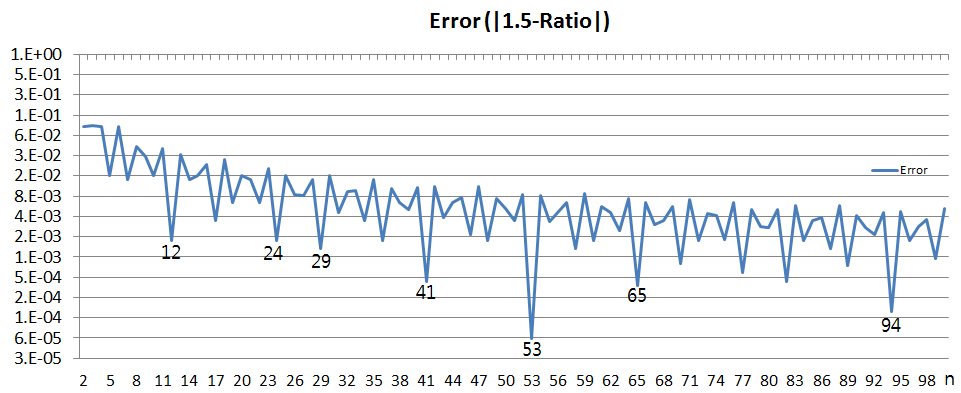
Finally, I plotted the error up to n=100 in Excel. As you can see, among divisions into 100 notes or fewer, splitting the octave into 53 notes gives the smallest error from the perfect fifth, at 5.91\times 10^{-5}.
All pitches have been recorded by Sony Sound Forge 7.0
Comments 26
지금 서양 음계는 바흐가 만들었다던데
힌두 음악은 22음계라던가..
화음이 제일 아름다운건 피타고라스때 음계라는 말도 들음, 가장 비례가 잘 맞는
암튼 졸 수고하셨음 ㄷㄷ
ㅇㅇ 그래서 완벽한 완전5도의 비율(1:1.5)을 음악계에선 Pythagorean Ratio라고 부르고 n=12인 경우에 생기는 오차를 음악계에선 Pythagorean Comma 라고 부르더군.
순정율과 평균율에 대해서 궁금한게 많았는데 정말 논리정연하게 설명이 되어 있어서 많이 배웠습니다.
한 가지 덧붙이자면 피타고라스의 순정율에 따르면 3을 곱하고 2로 나누는 방법만 쓴 것이 아니라 거꾸로 2를 곱하고 3으로 나눠주는 방법도 사용해서 12음계를 만들었습니다. 그 과정은 다음과 같죠.
먼저 도의 주파수를 f라고 했을 때 솔은 f*3/2, 레는 f*3^2/2^3, 라는 f*3^3/2^4, 미는 f*3^4/2^6, 시는 f*3^5/2^7, 그리고 파#은 f*3^6/2^9으로 만들고, 파는 f*2^2/3, 라#은 f*2^4/3^2, 레#은 f*2^5/3^3, 솔#은 f*2^7/3^4, 그리고 도#은 f*2^8/3^5 이렇게 만들어진 것이 피타고라스의 순정율입니다.
위와 같이 만들어진 피타고라스의 순정율에 12개의 음 사이의 주파수 비율을 계산해보면 약 1.0535배에서 1.0679배로 거의 비슷합니다. 다시 말해서 3을 곱하는 방식을 6번 반복하고 3을 나누는 방식을 5번 반복해서 12음을 만들면 음간격이 거의 비슷한 음계가 만들어진다는 말입니다.
따라서 바하가 평균을을 만들기 훨씬 이전의 음악인(또는 수학자?)들도 위와 같은 원리로 완전5도를 중심으로 12음계가 자연스럽게 나눠진다는 것을 알았을 것 같네요.
좋은 말씀 감사합니다.^^
피타고라스 순정율에는 2를 곱하고 3으로 나눠주는 방법도 사용되었었군요.
우연인지는 모르겠으나 놀랍게도 고대 터키음악에서는 한 옥타브를 53개의 음으로 구분했다고 한다. 위 그래프에서 보다시피 53은 100이하의 음으로 구분했을 때 가장 완전5도 화음을 정확하게 낼 수 있는 수이다.
아시겠지만 혹시 해서 두가지 사실을 남기고, 또 혹시 대답을 들을 수 있을까 해서 하나의 질문도 남겨 봅니다. 1. 동양 음계에서도 피타고라스 음계와 거의 동일한 방식으로 음계를 만드는데 삼분손익법이라고 합니다. 기준관의 길이의 1/3을 빼고, 새로운 관의 길이의 1/3을 더하고, ... 하는 식입니다. 12번 돌았을 때의 오차는 고려하지 못한 것 같습니다. 2. 한 스케일을 이룰 때 오차가 가장 작은 음의 갯수들인 5, 12, 29, 41, 53, 306, ... 는 Log3/Log2 를 얼마나 잘 근사할 수 있느냐로 결정됩니다. 이 무리수의 연분수 전개를 해서 적당히 자르는 것을 연분수 근사라고 하는데, 연분수 근사는 "수 x의 한 연분수 근사 p/q 는 분모가 q 이하인 모든 유리수 중에 가장 x에 가까운 유리수" 라는 좋은 근사 성질이 있습니다.Log[3]/Log[2]의 연분수 근사는 대략 [1; 1, 1, 2, 2, 3, 1, 5, 2, 23, ... ] 인데요, [1; 1, 1, 2] 는 분수로 쓸 때 분모가 5이고, [1; 1, 1, 2, 2] 까지 근사하면 분모가 12가 됩니다. 그 다음은 41이구요. 절대적인 음감이나 귀찮은 수치 계산 없이도 몇 개의 음을 사용해서 한 스케일을 구성하는 것이 좋을지에 대한 지식을 줄 수 있습니다.
질문입니다. 중임무황태나 pentatonic 같은 음계들은 정말 많은 문화권에서 발견되기 때문에 일종의 "자연스러운" 음계라고 생각하게 됩니다. 그렇지만, 중임무황태에서 중-임-무-황-태-중 의 간격은 일정하다기보다는 일부러 불균등하도록 짜여진 것 같습니다. 사실 12음계에서 7개의 음을 덜어내고 상속받은 것이지, 실제로 5개짜리 음을 통해 완전5도를 근사하자는 생각과는 거리가 먼 것 같습니다. 이것이 예전부터 좀 흥미로웠는데 어떻게 설명을 못 찾다가, 여기 주인장님께 여쭤봅니다!
줄바꿈이 안 먹히네요. 장황한 덧글 죄송합니다 ㅋㅋ
오오 그렇군요. 그런 식으로 하면 그 수열을 구할 수 있겠네요. 지적 감사드립니다. 중임무황태 같은 펜타토닉 스케일의 경우 임-무 사이가 다른 음들 간격보다 넓으니까 행인님의 말씀처럼 12음계와 직접적으로 비교하기는 어렵겠네요. 행인님께서 하신 질문은 저도 궁금하군요. 뭐 펜타토닉 스케일의 유래?에 관한 문헌들을 좀 뒤져보면 알 수 있을 것 같습니다.
그동안 궁금했던 것들이 쫙 정리가 되네요. 감사합니다. ^^
읽어주셔서 감사드립니다^^
ㅎㅎ 피타고라스 가 정리한 음계를 한번 살펴보시죠.. 그게 이겁니다 ㅎ뭐 완전 똑같진 안겠지만요 ^^
말씀 감사합니다. 피타고라스가 한 방식이 저런 방식인데 결국 조옮김에 취약하여 완전5도를 포기하는 쪽으로 갔다고 알고 있네요.
잘 봤습니다. 패드에선 음이 재생이 안돼서, 읽어도 뭔 뜻인지 잘 이해가 되지 않았는데 PC로 다시 보니까 이해가 됐습니다.마지막에 29음으로 재생되는 스케일이 있었으면 하는 바람이 드네요. 현재 스케일과 어떻게 다른지...ㅎㅎㅎ
아 그걸 깜빡했네요. 나중에 시간나면 한 번 해 보는걸로..^^
꽤 많은 음들이 한 스케일에 존재해도 좋아. 그 음들이 유한개라면.. 부터
해당 문단의 굵은 글씨랑 수식이 어떻게 나왔는지... 이해를 못한 사람입니다 ㅠ
직접 1.5의 n승에 1~2 사이에 들어올 때까지 2를 계속 나누는 작업으로
서양의 12음계가 어떻게 만들어졌는지는 이해를 했는데요...
올리신 게시글에 반음을 제외하고 8개의 음이라 하셨는데
분명 후에 재생되는 장음계에선
(계이름 기준)미와 파 사이, 시와 도 사이는 반음인 것으로 알고 있어서...
위의 부분에서 반음의 기준이 어떤 것인지 알려주실 수 있나요??ㅠㅠ
읽어주셔서 감사드려요~
Table 1에 3번째 열을 관찰하시면, 저런 방식으로 만드는 음들이 모두 어떠한 기준음 주파수의 "\frac{1.5^n}{2^m}, n,m은 자연수" 의 배수꼴로 나타남을 알 수 있습니다. 결국 이 배수 \frac{1.5^n}{2^m}가 1이 되어야 본래 기준음을 얻을 수 있게 되는데 이것이 당연히 불가능합니다.
지적해주신 부분은 제가 실수를 했네요. 감사드려요! 검은건반을 제외하고를 반음을 제외하고로 잘못 썼네요 ㅎㅎ. 말씀하셨듯이 그냥 장음계로 생각하시면 됩니다^^
오오 감사합니다!ㅎㅎ
아. 정말 대단히 감사드립니다. 나이 오십이 되어가는데 심심해서 색소폰을 배우기 시작한 beginner입니다. 음계와 옥타브등 음악적 원리에 대하여 궁굼하여 찾다가 이렇게 명쾌하게 설명을 하신것은 처음 보았습니다. 단번에 100% 이해가되네요. 정말 너무 너무 감사드립니다. 역시 음악의 기초가 튼튼해야 무슨 악기를 하던지 이론과 실체가 맞는것 같습니다. 감사합니다.
들러주셔서 감사드립니다. 도움이 되셨다니 다행입니다. 저것 역시 일종의 가설(?)일 뿐이긴 하지만요 ㅎㅎ
와 잘 보고 갑니다. 수식이랑 기타 등등 다 이해하긴 어렵지만 암튼 엄청 도움이 되었습니다. 음대에서도 음악을 이렇게 수학적인 측면에서 이해할 수 있도록 도와주는 수업이 있다면 정말 좋을텐데요. 학교가 아닌 곳에서라도공부를 할 수 있어 정말 다행입니다.^^
안녕하세요. 블로그를 보니 음악에 관심이 많으신 분 같네요. 도움이 되셨다니 다행입니다. 수학보다는 잡학에 가까운 측면이 있지만...
혹시 왜 7음 5반음으로 명명했는지는 알수없을까요? 상식적으로 12음이라면 6/6으로 나눴을것같은데...
12음계가 왜 12음계인지 설명하는 글은 제가 10여년간 찾아봤던 모든 자료들 중에서 이 글이 처음인 것 같습니다. 정말 훌륭하십니다. 말씀하신대로 29음계를 여러 음악가분들이 연구해서 화음과 작곡법이 개발된다면 정말 새롭고 흥미롭겠네요.
대단하네요.늘 궁금했는데 단번에 이해되네요감사합니다!
와...고맙습니다. 문득 음계마다 주파수가 어떻게 다른지 궁금해져서 검색하다 들어와서 잘 보고 갑니다.
음악에 대해서는 일자무식인 물리전공자 입니다... (악보의 계이름도 잘 못읽습니다...) 하지만 악기에서의 물리학 등에 대해 관심이 많아 음정에 대해 찾던중 글을 읽었는데 정말 명쾌하고 이하하기 좋게 설명이 되어있네요. 감사합니다.