Full Frame vs. Crop Sensor (APS-C) Cameras: Pros and Cons
Translated from the Korean original. Read the original →
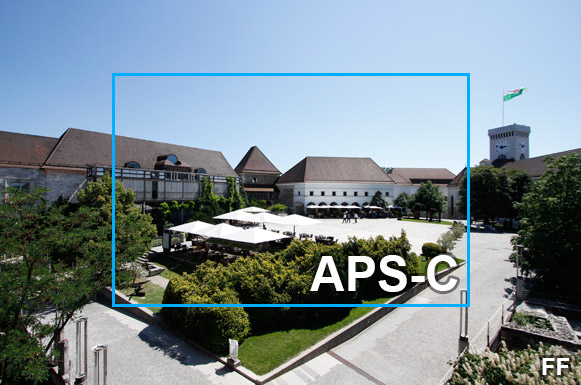
As the picture above shows, if you put a lens with the same angle of view on both and shoot the same scene, the crop-sensor camera loses a large part of the frame because its sensor is smaller. Even so, camera makers mass-produce crop-sensor bodies and push them as entry-level models, because a smaller sensor is cheaper to make and customers can buy them without breaking the bank. By the way, sensor size is one of the biggest factors in a camera's price. (If you ever damage your sensor and take it to a service center, you'll be hit with a repair bill that costs nearly as much as the camera itself. A real disaster.)
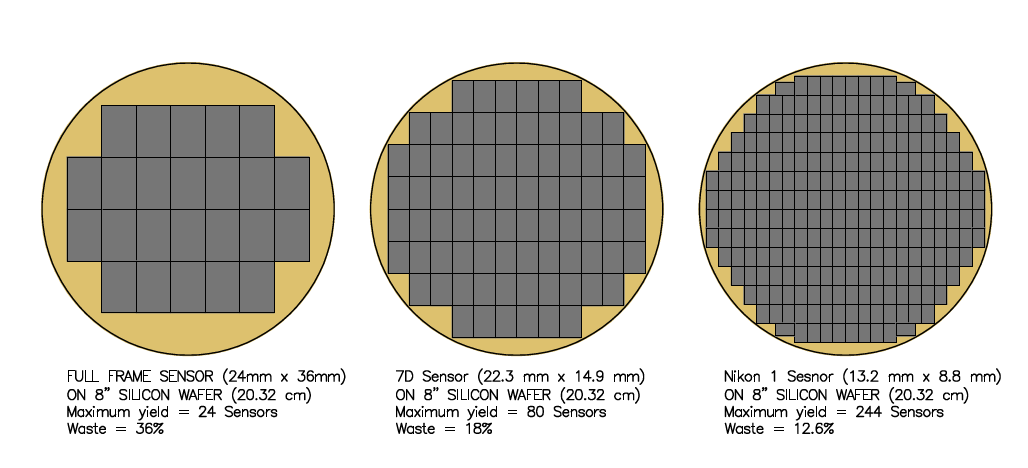
From a single wafer you can make only 24 full-frame sensors, while you can get 80 for a Canon EOS 7D and a whopping 244 for the Nikon 1 mirrorless camera! On a Canon, if you go to "Menu → Sensor cleaning → Clean manually," the mirror flips up and you can see the actual sensor with your own eyes.
Below, let's compare full frame and crop sensors point by point.
1. Price and size
This is probably about the only real downside of full frame compared to crop sensors. As I said above, the bigger sensor makes these cameras relatively expensive, and since the sensor is bigger, the body naturally gets bigger and heavier too. For example, the recently released full-frame Canon EOS 5DS costs over 4,000,000 won for the body alone, while the APS-C 70D goes for 900,000 won — under 1,000,000 won. Even allowing for the different release years, that's nearly a fourfold price gap... And it's not just the bodies — the lenses that go on them differ enormously in price too. Say you're putting a standard zoom on an APS-C body like the 70D: the usual picks are the EF-S 17-55mm f/2.8 (nicknamed the "blessing lens" in Korea), the Sigma 18-35mm f/1.8, the Sigma 17-50mm, or the Tamron 17-50mm. The EF-S 17-55 and the Sigma 18-35 are around 700,000 won, and the other two cost less than half that. Meanwhile, the typical lens for a Canon full-frame body is something like the EF 16-35mm f/2.8L II, which runs about 1,500,000 won. And of course, nobody buys a full-frame camera and stops at one lens... If you end up with three or four lenses, that's several million won more just on glass.
2. Angle of view
As I mentioned, full frame gives a wider angle of view than a crop sensor to begin with. In other words, with the same lens at the same distance from the subject, you can fit a lot more into the frame. Which naturally raises the question, "Can't I just buy a crop-sensor camera and put a wider lens on it? Isn't that the same thing?" The problem is that wide-angle lenses inevitably produce heavy "distortion," like this:
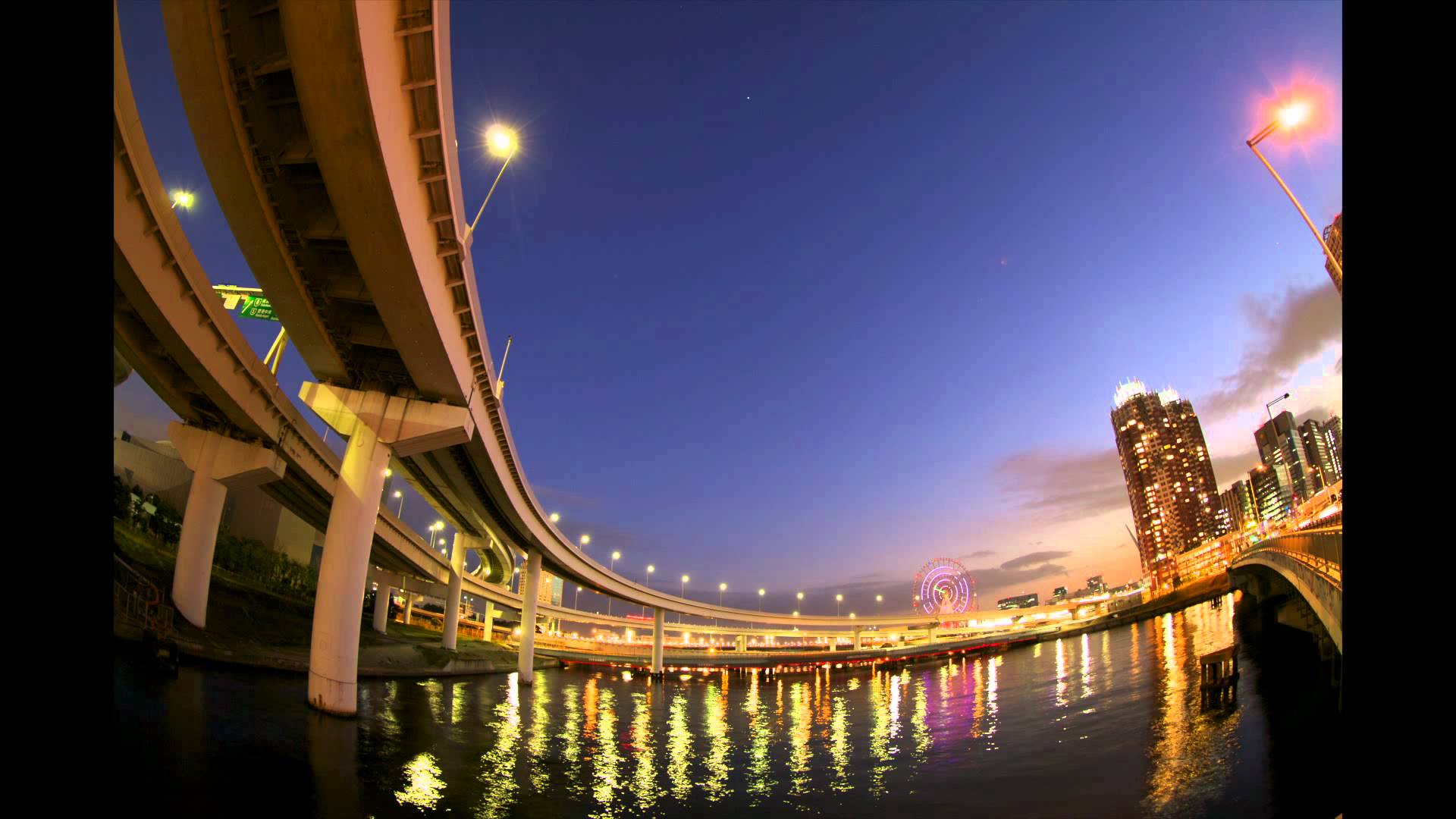
Used well, it can actually give your shots a unique feel. Another drawback is that wide-angle lenses usually get noticeably softer toward the edges of the frame. With a standard lens on a full-frame camera, you could capture the same scene in the same situation with almost no distortion, without having to reach for a wide-angle lens at all.
3. Depth of field
You often hear that crop-sensor cameras are at a disadvantage when it comes to shooting with a "shallow depth of field." A "shallow depth of field" goes hand in hand with "opening up the aperture" or "using a lower f-number." So in a shallow-DOF shot, only a tiny part of the subject is in focus and everything else is heavily blurred. In general, you get more background blur (1) the lower the f-number, (2) the closer the lens is to the subject, (3) the farther the subject is from the background (or foreground), and (4) the longer the lens. Point (4) means that, all else being equal, shooting with a telephoto lens from far away blurs the background more than shooting with a standard lens up close. The reason crop sensors are said to be worse at shallow depth of field is that, to frame the same subject at the same size, you have no choice but to step back farther than you would with full frame. That naturally puts more distance between the camera and the subject, while the subject ends up relatively closer to the background. So you lose out on conditions (2) and (3). Of course, with a crop sensor you can make up for it to some extent — for example by zooming in from farther away or getting a fast lens.
4. Image quality and high-ISO noise
This is actually what the pros call the big difference between crop and full frame, but honestly, hobbyists who mostly shoot in Av mode will have a hard time really noticing it. The first question that comes to mind is "Which has better image quality: a full-frame shot cropped afterward, or a shot taken on a crop-sensor camera in the first place?" In terms of pixel count alone, the crop sensor wins. Just compare a 35-megapixel APS-C camera with a 50-megapixel full-frame camera and it has to come out that way. To match it, a full-frame camera would need 35MP × (1.5)^2 = about 78 megapixels. But pixels aren't everything when it comes to image quality (just compare a phone camera and a DSLR with the same resolution). For one thing, a full-frame sensor is bigger, so it takes in more light, which means less noise and better image quality. No matter how many pixels a crop sensor packs in, it can't overcome the light-gathering gap that comes from the fundamental difference in sensor size. That said... unless you're making big prints, the difference you'll see on most devices seems pretty negligible. In the end, because of the format difference, full-frame cameras offer higher ISO settings than crop-sensor cameras, and even at the same ISO they have far less noise. So when it comes to controlling shutter speed, full frame wins hands down too.
So in conclusion... sadly, apart from price and the camera's weight and size, there's practically nothing a crop sensor does better than full frame. But if you weigh each of those points one by one, for hobbyists the benefit of going full frame isn't all that huge for the money (of course, if you've got cash to spare, it's full frame with L lenses, no question...).
* Photo sources
(1) https://shuttertutorials.wordpress.com
(2) http://www.cambridgeincolour.com/forums/thread47983.htm
(3) https://www.youtube.com/watch?v=RkrQp77XeqQ
More in Camera & Lens
See all- Sony CX-550 Camcorder Review After Five Years of Use (vs. Canon 70D Video)
- How to Check Your Camera's Shutter Count (Canon EOSMSG)
- Full Frame vs. Crop Sensor (APS-C) Cameras: Pros and Cons(1)
- Canon EF-S 24mm F2.8 STM Pancake Lens Review: Real-World Shots on the 70D
- Do You Really Need a Lens Filter (UV Filter)?
Comments 1
크롭 카메라도 나름대로 사진을 잘 찍을 수 있으니 너무 미워하진 마세요. 하지만 펜탁스는 까야 제맛이죠.